

Selecting bricks
Question continues: "The walls are 3m high by 4.5m wide by 0.2m thick, and supported at each end of the 4.5m I believe this will have a fire rating of 240 minutes? How do I support the wall for strength against wind? Are steel wire wall ties sufficient? "
ANSWER
You do not need a special type of brick such as a fire brick. I suggest a double skin masonry wall in standard imperial clay brick, with each leaf 106 mm in thickness. This will yield an overall wall thickness (unplastered) of 212 mm which will have a nominal fire rating of 240 minutes.
I would recommend supporting each 4 meter length of wall with a 340 x340mm brick pillar at each end, as well as using wire ties (brickforce) as suggested.
Chris Dickinson
Corobrik
Full Question
Referring to SANS 1575 Burnt clay paving units Modulus of rupture 7.6.11
c) a mechanism capable of applying a force uniformly along the cylinder and of increasing the stress at a rate of 1MPa +- 0.2MPa per second.
What would be the load rate in Newton's per second for a sample 200mm long x 100mm wide x 50mm thick?
Answer
1 pascal = 1[N/m²] therefore 1Mpa = 1 000 000 [N/m²] or for ease of calculation 1 MPa = 1000[kN/m²]
Martin Hughes
Corobrik
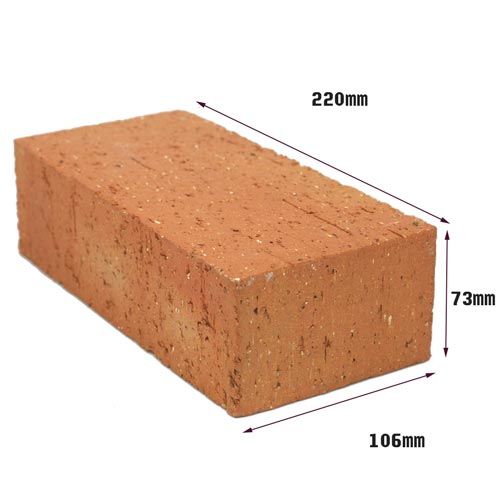
The standard imperial size is 222mm long x 106mm wide x 73mm high with a mass of between 3.0kg and 3.5kg.
Two important criteria determine this size. First, it is the ideal width for the human hand to lift and place in position with minimum strain and secondly, it satisfies the need for bricks to be modular in terms of BOND patterns. Thus there is an approximate arithmetic relationship of length to width of 2:1 and in length to height of 3:1, which allows for bonding in any direction.
However every manufacturer can offer and range of sizes and dimensions to suit different applications.
Common brick sizes
|
LENGTH (mm) |
222 |
222 |
222 |
222 |
222 |
190 |
190 |
290 |
290 |
390 |
|---|---|---|---|---|---|---|---|---|---|---|
|
WIDTH (mm) |
90 |
40 |
90 |
140 |
110 |
90 |
106 |
90 |
150 |
190 |
|
HEIGHT (mm) |
73 |
73 |
114 |
114 |
73 |
90 |
90 |
90 |
190 |
90 |
Superbricks & Maxis
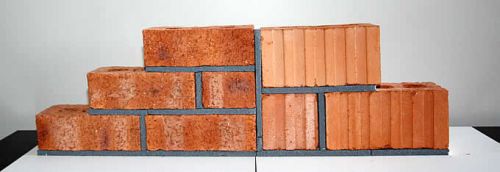
“Superbricks” come in a range of non-standard, large sizes that lower material costs, use less mortar and have fewer joins per square metre. With 140mm wide bricks, one can build a single leaf wall that meets SABS10400XA for a single leaf wall.
For winter rainfall coastal regions, manufacturers have developed brick formats that are narrower and taller than the imperial brick to reduce labour and costs of double skin cavity wall construction.
Fewer bricks per m² afford savings in mortar and accelerate the speed of construction consequent to fewer bricks per m² laid. But as this is still a double leaf wall, the property owner still enjoys all the benefits of double leaf cavity clay brick walling
Special Shapes
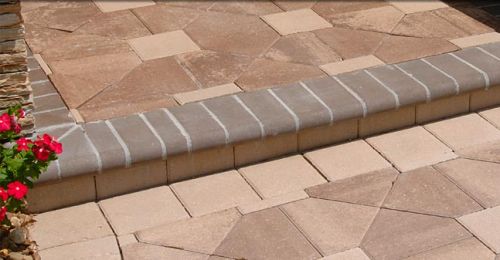
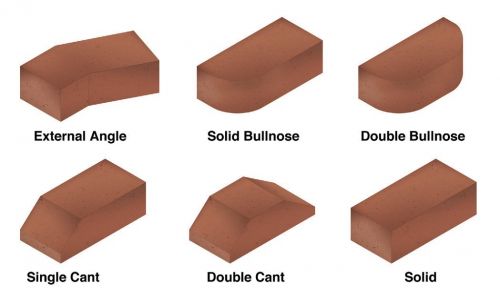
A range of special shapes are available to enhance the aesthetic detailing of buildings and landscaped areas. The most common specials available are the cants and the bullnose bricks although special shapes can also be manufactured to specification. It is advisable to discuss your requirements with your supplier.
When ordering or specifying clay bricks, ensure the following points are discussed and made known to the suppliers:
- Expected sizes. Not all bricks are manufactured to the standard imperial size of 222mm long x 106mm wide x 73mm high
- The required application e.g. type of building, finish etc.
- The degree of exposure to weather conditions, closeness to the seas etc.
- The track record of the preferred brick in the area where you are building
- An undertaking or warranty from the brick supplier that the bricks delivered will be fit for purpose
- Colour expectations in the case of face bricks or exposed brick areas
- The acceptable levels of breakage during delivery to site
- The the brick manufacturer registered with the Clay Brick Association of SA.
To avoid colour banding it is highly recommended that face bricks are taken from a number of different packs and carefully blended during building operations.
Properties that require consideration when buying or specifying clay brick are:
- Compressive strength (varies from 7MPa to 50MPa)
- Water absorption (face brick up to 10%, NFP up to 16%)
- Modulus of rupture - strength in bending
- Moisture expansion - important when detailing long walls
- Initial rate of absorption: This affects the development of bond between the mortar and the brick. Bricks with high rates of absorption (often lower quality) may require pre-wetting well before laying to prevent absorbing excessive water from the mortar mix. Trial and error experiments when bricks arrive on site will determine the need to pre-wet bricks.
A refractory brick is built primarily to withstand high temperature, but will also usually have a low thermal conductivity for greater energy efficiency. Usually dense firebricks are used in applications with extreme mechanical, chemical, or thermal stresses, such as the inside of a kiln or a furnace, which is subject to abrasion from wood, fluxing from ash or slag, and high temperatures.
In the making of firebrick, fireclay is fired in the kiln until it is partly vitrified, and for special purposes may also be glazed.
High-grade fire clays can withstand temperatures of 1775 °C (3227 °F), but to be referred to as a "fire clay" the material must withstand a minimum temperature of 1,515 °C (2,759 °F). Therefore Fire bricks are not needed in braai or fireplaces - a good quality FBX brick will be more than sufficient for the bed of the fireplace, while a standard FBA or NFP brick is sufficient for the sides.
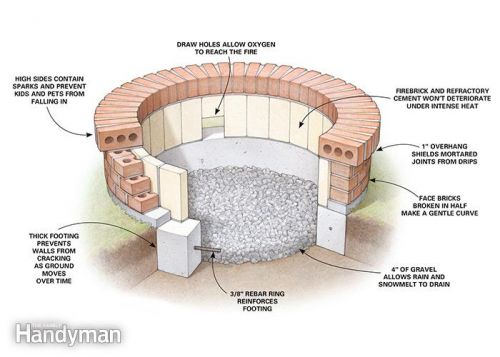
Firebricks (or refractory bricks) are totally over-specification in a domestic fireplace or braai. They are also expensive and not easily available. Refractory Bricks are normally rated from around 1600’C upwards - a braai will never reach this heat.
Any clay face brick or semi-face (fired) brick can be used for a braai. Facebricks are fired to around 1000 – 1250’C to stabilise their structure, and they have a high thermal mass which helps them insulate for heat. The heat in the fireplace would need to be higher than this to have any effect on the brick.
Concrete bricks or any regular concrete product made with Portland cement cannot stand up to high temperatures and will disintegrate at the temperatures required by a pizza oven or braai.
With excessive heat, cement and mortar between the bricks can crumble. Build the outer skin of the sides of the braai/fireplace with a standard mortar mix (1 bag cement : 3 Barrows Sand) with brickforce and cavity ties. Build the inner skin with a well burnt clay face brick (FBX) using a weaker mix (1 bag : 6 Barrows Sand) – this allows more joint movement and reduces cracking from heating.
The base is normally the area that gets the most heat as the fire is resting on this. Here a clay paver or solid clay brick should be laid on a sand bed. Do not cement bed or grout – it must have some movement to allow for heating and cooling expansion / contraction. The bricks / pavers at the opening to the braai can be grouted in to form an edge restraint. The fire generally is never built right at the opening so they don’t get as much heat. Grouting these prevents the pavers behind from falling out / working loose. It acts like a kerbing.
For the sides or a raised bed, you can use an air-set refractory cement (as oppose to a fire-set refractory cement), and minimize the joint space between the bricks – use “buttered joints” i.e. have the bricks very close together.
To avoid confusion and to standardize, the following terminology was introduced and is currently used by the industry.
FBS - FACE BRICK STANDARD
Clay bricks that are selected or produced for their durability and uniformity of size and shape.
NFP - NON-FACING PLASTERED
Clay bricks suitable for general building work that is to be plastered
FBX - FACE BRICK EXTRA
Clay bricks that are selected or produced for their durability and high degree of uniformity of size, shape and colour
NFX - NON-FACING EXTRA
Clay bricks suitable for use, plastered or unplastered, for general building work where durability rather than aesthetics is the key selection criteria: below damp-proof course or under damp conditions or below ground level
FBA - FACE BRICK AESTHETIC
Clay bricks that are selected or produced for their durability and aesthetic effect deriving from non-uniformity of size, shape or colour.
...E - ENGINEERING UNITS
Masonry units produced for structural or load-bearing purposes in face or non-face work, where the manufacturer suppliers clay bricks to an agreed compressive strength. An engineering unit is designated by the addition of the letter E followed by a number equal to the nominal compressive strength in megapascals eg FBSE21.
PA - CLAY PAVERS (1:1, 2:1 OR 3:1)
Clay pavers that are selected or produced for their durability and for a high degree of uniformity in size and shape, and that have dimensions such that the ratio of work size length to work size is approximately 1:1, 2:1 or 3:1.
PB - CLAY PAVERS
Clay pavers that are selected or produced for their durability and for their uniformity in size and shape.