

Building with bricks
The following recommendations deal with vehicles and associated equipment and their use:
- High Pressure washers should not be used on clay brick, as they remove the surface which will result in deterioration over time.
- Equipment should be purpose designed to sweep the particular area. If there is any doubt, the vehicle manufacturer should be consulted.
- Tyres should be inflated according to the manufacturer’s recommendations to ensure maximum weight distribution.
- Polypropylene, not wire, brushes should be used.
- Sweeping brush pressures should be set to the minimum required to suit the particular task, i.e. surfaces swept regularly will require a lesser setting than those swept infrequently or those covered with heavy deposits.
- When sweeping, engine revolutions should be set at the minimum required to maintain vacuum (suction) pressure.
- Operators, including reliefs, should be trained to vehicle manufacturer’s recommendations and tyre and brush pressures should be regularly checked.
- Advice should be given to operators that, when equipment is stationary or left unattended, suction, brush rotation and water jetting equipment should be switched off to avoid the risk of damage to the area below the stationary equipment.
- In new or re-laid areas, agreement should be reached with the local Highways Authority to allow the pavement to settle and the joints to seal before manual cleaning.
- When water jetting equipment to wash such areas is used, the jets or hand held lance should be directed at the surface at an angle not greater than 30o and across the diagonal (i.e. not parallel to joints) using a suitable detergent solution.
- The area should be inspected after cleaning to ensure that joints are refilled with jointing sand if necessary.
The SACPCMP prescribes the registration of Construction Health and Safety Officers as a specified category in terms of section 18(1) (c) of the Act No. 48 of 2000. See the attached document for full guidelines. For additional detail about registration and services, see the website of The South African Council for the Project and Construction Management Professions (SACPCMP) (www.sacpcmp.org.za).
Services of the Health & Safety Officer during the construction phase of a project include:
- Assist with the preparation of a construction health and safety plan
- Confirm necessary documentation was submitted to the relevant authorities
- Attend project planning meetings
- Assessments and approval of contractor(s) health and safety plans
- Attend the contractors site handover
- Attend regular site, technical and progress meetings
- Facilitate site health and safety meetings
- Identification of the hazards and risks relevant to the construction project through regular coordinated site inspections
- Establish and maintain health and safety communication structures and systems, distribution of health and safety specific documents to sub-contractors
- Compiling project specific emergency response and preparedness plans
- Testing the effectiveness of the emergency response plans
- Conduct site safety inductions
- Evaluate the levels of compliance of subcontractors to the project specific health and safety plan and client specifications through inspections and audits
- Oversee the reporting and investigation of project related incidents
- Oversee the maintenance of all records
- Participation in management reviews of the health and safety systems
- Use of trends analysis to identify system deficiencies and incident trends, outline relevant improvements
- Incorporation of changes into a health and safety management system
- Review and update the health and safety plan
- Development of technical reports in relation to health and safety issues and communicate through presentations to diverse groups of decision makers


The gaps on the pavers are 2mm to 6mm, which are to account for both PA and PB pavers so that lines may be maintained. (see the tolerances in the spec’s on both types of pavers)
The "nibs" technically are only to assist with laying and are not for any structural reason. Most nibs are offset so as not to end up contacting each other, but strictly speaking, the jointing material is designed to diffuse the lateral and vertical forces by transferring them through to the bedding sand and sub-bases layers.
It is highly recommended that the grade of jointing material is different to the bedding sand, to expand in the joints and create the lockup. It must also be vibrated so that it fills the joint to the bottom and in so doing allow the forces to be transferred through. Again, one of the more important issues in the design is the edge restraint which holds the whole system together, and patterns relevant to the usage are also critical.
Please download the "Movement of Brickwork" technical paper.
Firstly, what is Brickforce?
Brickforce is a British brand consisting of two main parallel wires joined by in-line welded cross wires. Main wires are manufactured to a flattened profile to simplify location into the mortar joint without steel build-up problems at lap positions corners/junctions or when used in conjunction with wall ties.
There are various other materials that can be used for brick reinforcement, e.g. Mild steel reinforcing rods and expanded metal. These products and others suitable as brick reinforcement are obtainable in rolls of varying lengths and widths, from your local hardware shop or builder supplies merchants.
Why use masonry reinforcement?
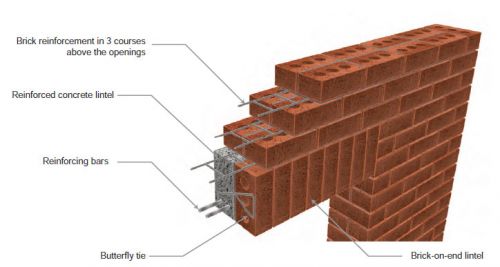
Masonry has excellent compessive qualities and the majority of buildings constructed using this material last for many years with little maintenance. However, masonry has no significant tensile strength and movement caused by substrata changes, moisture or thermal effects can cause cracking.
The use of masonry reinforcement is a very simple and cost-effective way of greatly enhancing the strength and durability of masonry construction by providing both structural and crack control benefits.
It ties the wall together thus providing stability. Over unsupported openings like windows ,doors etc., Brickforce strengthens the wall. If you are building on unstable ground (i.e. there is movement in the ground) it is always good practice to use brick force thus ensuring a very stable wall.
Various types of alternative masonry reinforcement products are also available including mesh and wire.
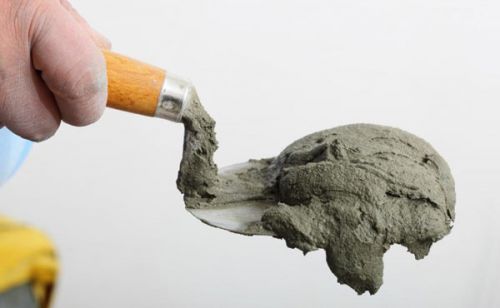
Cement
Cement is a binder. Similar to flour in a recipe, the purpose of cement is to hold the other materials together. But you can’t just use cement alone. You need the other materials and what you mix with the cement will determine the final product.Cement is made from limestone, calcium, silicon, iron, and aluminum, among other ingredients. This mixture is heated in large kilns to about 2,700°F (1,482°C) to form a product known as clinkers, which roughly resemble marbles. These are ground into a powder and gypsum is added, creating the gray flour-like substance known as cement. When water is added to cement, it triggers a chemical process that allows it to harden.There are many different types of cement, but the type most commonly used in construction is Portland cement.
Concrete
Concrete is a composite of aggregate (such as sand or gravel), cement, and water. The cement makes up from 10 -15% of the total mass of concrete; the exact proportions vary depending on the type of concrete being made. Aggregate makes up more than 60% of a concrete mix — and up to 80% in some cases. The aggregate gives the concrete its mass, and the water activates the cement holding it all together. What proportions of the mix will determine the strength, resistance to freeze and thaw, workability, and how long it takes to harden.
Because it needs a low water to cement ratio, it is much thinner when mixed, making it difficult to use as a bonding element. Concrete is used in structural projects and is often reinforced with steel rebar to maintain its structural integrity as the soil beneath it settles. It is best used for support, such as beams, walls, or other building foundations.
Mortar
Mortar is used to hold building materials such as brick or stone together. It is composed of a thick mixture of water, sand, and cement. The water is used to hydrate the cement and hold the mix together. The water to cement ratio is higher in mortar than in concrete in order to form its bonding element. When mixed, it is a much thicker substance than concrete, making it ideal as a glue for building materials like brick.
Well-made clay bricks should never require wetting before laying except (rarely) under extremely hot and windy conditions.
Pressed or extruded bricks of low porosity should never be wetted prior to bricklaying as they naturally have a significantly reduced water uptake (and almost zero with a Class A engineering brick) that, if wetted, would result in the brick retaining a thin film of water on all its surfaces and this would cause it to ‘swim’ on the bedding mortar; and that invariably leads to it both sliding out of face line and sinking out of level. If this happens adjust the water content of the mortar so that it is used as stiff as possible.
Clay bricks purchased from non-accredited sources could have unacceptably high porosity and water absorption rates and might need to be soaked on site with water before being used.
With highly porous bricks there is a danger that they might rapidly absorb moisture from the bedding mortar (particularly in warm weather) causing it to stiffen quickly. This would result in it losing the all-important characteristic of plasticity that would inhibit correct and accurate positioning to line and face-plane and the provision of a secure bedding, leading to poor adhesion with attendant negative consequences on aspects of compressive and flexural strengths of the overall walling.
How much water do I need on older or porous bricks?
The amount of water required to sufficiently dampen the bricks and reduce their absorbency to a level ideal for bricklaying comes with experience, but a brick that has been sufficiently dampened should not leave the hand wet when held.
There is a big difference between a brick that is ‘soaked’ and one that is ‘saturated’. A brick that has been soaked has a high percentage of moisture content, but retains sufficient available pore space to still provide the all-essential water uptake, or suction, necessary for it to be properly bedded into, and adhering onto, the fresh bedding mortar. A brick that has been saturated, however, has had all available pore space filled with water. In such a case there is no longer an ability for water uptake, with seriously reduced adhesion, or suction, so the brick ‘floats’ on the mortar; and it can even begin to shed its excess moisture into the bedding mortar that can result in it leaking out of the joint and staining the facework immediately below.
With some new bricks, a further possible problem is that saturation can liberate any integral soluble salts into solution resulting in disfiguring efflorescence (white salts) crystallising on the face of the bricks.
Bonding brickwork means the arrangement in brickwork so that the units are tied together to form a solid mass. The load is then evenly distributed along the length of the wall.
These drawings show what happens to a wall that is not bonded and one that is bonded.
There are two methods of lapping:
- The half brick lap
- The quarter-brick lap, also known as the half bond and the quarter bond.
If bricks are so placed that no lap occurs, the cross joints or perpends are directly over each other, and we have what is known as ‘straight joints’, which must be avoided at all costs.
There are basically three types of bonds used in South African construction and examples of all three can be seen in all towns and cities, - the Stretcher Bond, English Bond and Flemish bond.
Stretcher bond
(alternate layers of stretchers)
Consists of bricks laid lengthways along the line and mapped. This is by far the most commonly used bond in South Africa. In cavity wall construction this is the most economical bond to employ.
English bond
Consists of alternate courses of headers and stretchers. This bond is believed to be the strongest bond because of the header across bonding. It is usually employed in foundation walling behind the half-brick outer skin, and for retaining walls
Flemish bond
Consists of headers and stretchers in the same course.


Are you planning a major project? Our user friendly guide "Bricklaying made Easy" is available at Builders Warehouse, or from the CBA for just R150.
Preparation
- Plan site layout e.g. position of building, material stores, access etc.
- Store and protect all materials to minimise saturation and contamination.
- Control the wetting of bricks in hot, windy weather.
- Do not lay surface saturated bricks.
- Set out at ground level to locate all openings before commencing bricklaying.
- Lay out dry and minimise broken bonds.
- Prepare and take care of gauge rods - they are important quality control equipment.
- Work all levels from one datum.
Protection of brickwork
The best treatment is to prevent it from getting dirty in the first place - so protect the wall as work progresses from mortar droppings. After the first course of bricks has been laid - protect the base of the wall by laying sand, straw, sawdust or plastic sheeting along the ground. This minimises mud splashes and damage from mortar droppings.
As clay brickwork should be kept dry as possible during construction, cover the walls at the end of each day's work and during rain in order to keep brickwork free from mortar stains.
At the end of each working day clean the toe boards closest to the wall and turn the boards back to prevent rainfall from splashing mortar and dirt onto the brickwork.
Process & Techniques
- Mix small batches of mortar to suit building rate and 20 minute initial set timing.
- Bed all DPC's on fresh mortar
- Blend face bricks from a number of packs to minimise colour bonding.
- Plumb, level and square brickwork
- Fill all mortar joints solidly to minimise water penetration.
- Clean mortar dropping from cavities regularly

Mortar must not be used after it has started to set, which usually occurs about two hours after it has been mixed. One man – particularly if he is a weekend builder – can probably lay a little more than 60 bricks an hour. If you are working on your own or with one assistant, it is better to mix a number of small batches as they are required than to mix a one-bag batch. Do not use too thick a layer of mortar between bricks or blocks; this is wasteful and may lead to cracking.
Mortar class
- Class I: Highly stressed masonry incorporating high-strength structural units such as might be used in multi-storey load-bearing buildings; reinforced masonry.
- Class II: Normal loadbearing applications, as well as parapets, balustrades, retaining structures, and freestanding and garden walls, and other walls exposed to possible severe dampness. In practice, Class II mortars are used for most applications.
The amount of water added to a mix must be enough to make the mix workable and plastic
Masonry cement must comply with SANS 50413-1: Strength class 22,5X. The addition of lime to masonry cements is not permitted
MORTAR:
- For laying bricks and blocks in normal applications (SABS Class II)
- To lay 1000 bricks = 3 bags cement + 0.6 cu. m. sand
- 1 Bag of cement to 3 wheelbarrows of building sand
PLASTER:
- For exterior and interior work
- To lay 100sq.m. (15mm thick) = 10 bags cement + 2 cu. m. sand
- 1 Bag of cement to 3 wheelbarrows of plaster sand

The cost and quality of masonry work is significantly affected by the mortar used. Mortars may account for as little as 7% of the volume of the walls, but the role it plays and the influence it has on performance are far greater than the proportion indicates. Mortar provides a bed for laying; bond units together to give compressive and flexural strength and seals joints against rain penetration.
Four types of building mortar are detailed in SABS 0164.
|
COMMON CEMENT |
Sand |
|
COMMON CEMENT |
Lime: sand |
|
COMMON CEMENT |
Sand plus mortar plasticizer |
|
MASONRY CEMENT |
Sand (common = Portland) |
Approximate proportions for mortar:
|
MORTAR CLASS |
COMMON CEMENT lt |
LIME lt |
SAND MEASURED LOOSE & DAMP litres mix |
MASONRY CEMENT kg |
SAND litres |
|
II |
50 |
0-40 |
200 |
50 |
170 |
|
III |
50 |
0-80 |
300 |
50 |
200 |
- Class II: Normal load bearing applications, as well as parapets, balustrades, retaining structures, free-standing and garden walls and other walls potentially exposed to severe damp conditions.
- Class III: Lightly stressed (e.g. single storey) bearing walls where exposure to dampness is not severe but check NBR and NHBRC.
Cementitious Materials
CEM 1 32.5 (ordinary Portland cement) and CEM 11/A (S,V or W) 32.5 (Portland cement 15) may be used in mortar.
It is not advisable to use CEM 111/A 32.5 (PBFC), unless the mortar sands are good quality. Mortar with common cement lacks plasticity, may bleed, and will be harsh to work with. This deficiency may be overcome by using masonry cement. The use of lime in the mortar mix is beneficial but is difficult to obtain. Masonry cements are readily available.
When sealed in airtight drums, cement remains the same in strength for up to 3 years. When packed in sacks, even under good conditions, deterioration in the strength of the cement will occur, with a prolonged shelf life, for example: 20% loss after 3 months, a 30% loss after 6 months and a 40% loss after 1 year. The arrangements for storing or stocking cement should be such that batches are used in the same order in which they were received. First in - first out.
Sand
Sand for mortar should comply with SABS 1090 and be well graded from 5mm downwards. Sand should be evenly graded and should not contain an excess of dust or other fine material. The use of fine sands, that are more or less uniform in particle size, may contribute to workability, but frequently leads to excessive shrinkage and cracking of the joints. Sands containing high percentage of clay, tend to give a conveniently plastic mix, but also leads to undue shrinkage.
Lime
Lime used in mortar is hydrated lime (commercial bedding lime) and not quicklime or agricultural lime. Lime give the best results when used with coarse sands. Lime with clayey sands can make the mortar over-cohesive and difficult to use. Lime should not be used with masonry cement.
The use of limes added to cement mortars is recommended as the improved workability and water retentively will lead to superior brick to mortar adhesion, with improved resistance of the brickwork to rain penetration.
The acceptable water absorption rate for face bricks ranges from 4.5% to a maximum of 12%.
The acceptable water absorption for clay plaster bricks is between 12% and 20%. If you are using engineering bricks the closer you are to the 12% the better the result will be. When the water absorption rate of a plaster bricks is too low, i.e. below 12%, it may be difficult for plaster to obtain a proper adhesion to the plaster brick.
Handmade historic bricks; many of which are often found to have an average porosity value of around 35%.
With highly porous bricks there is a danger that they might rapidly absorb moisture from the bedding mortar (particularly in warm weather) causing it to stiffen quickly. This would result in it losing the all-important characteristic of plasticity that would inhibit correct and accurate positioning to line and face-plane and the provision of a secure bedding, leading to poor adhesion with attendant negative consequences on aspects of compressive and flexural strengths of the overall walling.
It is important not to confuse ‘porosity’ with ‘permeability’, as they are not the same. Porosity is a measure of the available pore space within a brick. Permeability, however, is a measure of the extent to which air, water, or other fluid can pass through a brick, and depends on the pore structure and degree to which these pores constitute a means of transporting from the face to the rear of the brick. A brick can be highly porous, yet impermeable, because if its pores are not interconnected then no water falling on its face can pass through them to the back.
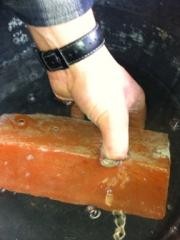
Clay bricks expand fractionally after leaving the kiln (primarily due to moisture in the air) and minute increases in height and width (0.006 percent per annum) continue at a decreasing rate for up to 5 years.Fortunately with clay products the majority of this expansion happens almost immediately the product leaves the kiln and is exposed to atmosphere.
In the good old days all the bricks would be purchased at the beginning of a project and stored for many months before being used. It was thought this gave them an opportunity to harden and "dry out". Today, purchases are JIT (just-in-time) and the timing from order email to delivery to use is less than a week. The age of bricks in stock will vary considerably from factory to factory and region. Obviously if product is in high demand they do not stand too long in the yard before delivery.
There are many sources of movement in walling and paving including ambient moisture levels, temperature, loading and creep, chemical action, ground movement and settlement. For more information, please download the "Movement of Brickwork" technical paper.